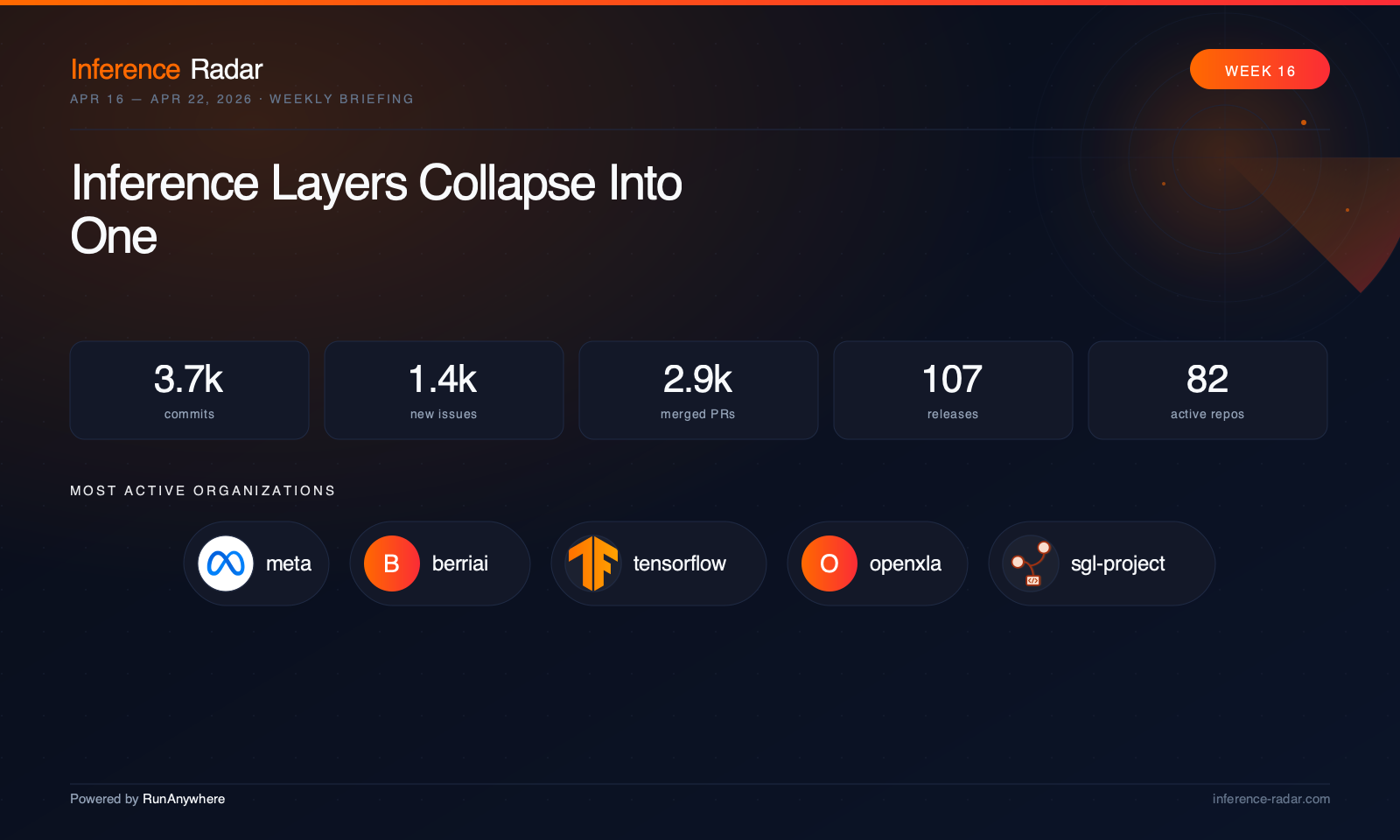

TL;DR
- vLLM and NVIDIA pushed the datacenter performance frontier: vLLM landed ROCm FP8 GEMM acceleration while TensorRT-LLM doubled down on AutoDeploy sharding, KV-cache handling, and disaggregated serving.1
- Apple Silicon became a first-class serving target, not just a dev box: Apple MLX, mlx-lm, and fast-moving MLX ecosystem projects shipped concurrency, batching, parser, and server fixes that make Mac inference look more like a real deployment platform.3
- Local runtimes raced to stabilize Gemma, Qwen, and tool calling: Ollama, llama.cpp, oobabooga text-generation-webui, and LocalAI all spent the week fixing reasoning tags, multimodal behavior, parser edge cases, and launch-time UX.5
- Edge frameworks are getting more serious about production ergonomics: ExecuTorch, LiteRT, sherpa-onnx, and Cactus focused on real deployment issues like Metal MoE support, OpenVINO integration, desktop/mobile packaging, and constrained-device memory behavior.9
- Compilers and runtimes are back in the critical path: OpenVINO, ONNX Runtime, TVM, Triton, and TileLang all shipped low-level fixes that directly affect whether modern models actually run fast — or correctly — on real hardware.13
This Week in Inference
The most important pattern this week is that inference engineering is no longer splitting neatly into cloud, local, and edge camps. The same themes showed up everywhere: KV-cache efficiency, speculative decoding, tool-calling correctness, multimodal parsing, and hardware-specific kernel work. vLLM, SGLang, and TensorRT-LLM pushed on throughput and distributed serving, but local-first projects like llama.cpp, Ollama, and Apple MLX were solving strikingly similar problems for laptops and workstations.1 The stack is converging around shared operational concerns, not deployment labels.
A second pattern: Apple Silicon is graduating from “nice local demo target” into a serious inference platform. MLX improved concurrency, CUDA interoperability, and kernel behavior, mlx-lm tightened server and tool-calling correctness, and adjacent projects like mlx-vlm and vllm-mlx added continuous batching, OpenAI-compatible responses, constrained decoding, and multimodal fixes.3 In parallel, ExecuTorch expanded Metal support for MoE models, and coremltools fixed a conversion bug that could silently produce NaNs in fp16 LLM exports.9 Apple hardware is no longer just where people test models; it is increasingly where they expect to serve them.
The third pattern is less glamorous but more consequential: correctness work dominated. Open WebUI spent the week stabilizing a major release, LiteLLM raced to restore provider compatibility, ai-dynamo pushed hard on OpenAI Responses API fidelity, and ONNX Runtime and OpenVINO shipped overflow checks, bounds validation, and execution-provider fixes.13 That’s the real state of the market: not a week of flashy new abstractions, but a week where the projects that matter got better at surviving production reality.
Top Stories
vLLM sharpens its accelerator story vLLM spent the week making performance gains feel less NVIDIA-exclusive, most notably with ROCm FP8 GEMM acceleration through AITER-backed kernels.1 At the same time, the project kept tightening serving behavior, multimodal correctness, and platform support across CPU, XPU, and Ray-integrated deployments. The result is that vLLM looks less like a single fast server and more like a portability layer for serious inference across heterogeneous fleets.
TensorRT-LLM turns sharding and KV-cache management into the main event NVIDIA TensorRT-LLM had one of the biggest infrastructure weeks in the ecosystem, centered on AutoDeploy sharding, disaggregated serving, and cache-management fixes.2 That matters because the bottleneck in large-model serving is increasingly orchestration, not raw kernel speed. NVIDIA is clearly trying to make TensorRT-LLM the control plane for large-scale deployment, not just the fastest path on a single box.
Apple MLX crosses from framework to serving substrate MLX and mlx-lm shipped the kind of changes you only prioritize when people are using your stack in anger: thread-local stream fixes, batching stability, parser repairs, and broader kernel/runtime improvements.3 Around them, projects like mlx-vlm, mlx-audio, and vllm-mlx added continuous batching, speculative decoding, and OpenAI-compatible server behavior.19 The MLX ecosystem is starting to resemble a full inference platform, not a niche Apple-native curiosity.
llama.cpp keeps widening the definition of “local runtime” llama.cpp had a classic high-velocity week: WebGPU improvements, speculative decoding checkpointing, multimodal model support, and backend work across OpenVINO, SYCL, Hexagon, CUDA, HIP, Metal, and Vulkan.6 That breadth is the point. llama.cpp is increasingly the reference implementation for “run anywhere” inference, spanning browsers, desktops, NPUs, and edge devices without giving up on modern model features.
ExecuTorch and LiteRT make edge inference look more like mainstream infrastructure ExecuTorch expanded Metal support for MoE models and kept hardening Android, QNN, XNNPACK, and Arm paths, while LiteRT added Intel OpenVINO execution and continued cleaning up runtime/plugin boundaries.9 These are not hobbyist changes; they are the kind of platform work required to make on-device inference predictable across vendors. Edge frameworks are starting to inherit the same expectations as cloud serving engines: compatibility, observability, and sane deployment surfaces.
Deeper Dive
Everything below is for readers who want the full picture. Feel free to scroll.
Code Changes by Category
Cloud & Datacenter Serving
vLLM had the most important pure serving release of the week, but the deeper signal was its continued diversification beyond CUDA-first assumptions.26 ROCm FP8 GEMM via AITER, multimodal M-RoPE fixes, quantized model loading improvements, and Ray compiled-DAG stability work all point to the same direction: vLLM is trying to be the default serving layer across mixed fleets, not just the fastest OpenAI-compatible server on NVIDIA. The Gaudi plugin reinforced that theme with dramatic compile-stability gains for Llama-family models and fewer graph breaks on Qwen and MoE paths.
SGLang had one of the busiest weeks in raw engineering terms.27 The project pushed speculative decoding compatibility, streaming-session fixes, CPU 4-bit GPTQ/AWQ support, AMD diffusion work, and a new plugin architecture for vendor extensions. The plugin move matters strategically: it’s an attempt to scale hardware support without forcing every backend vendor into a long-lived fork. That’s exactly the kind of architecture decision you make when a project is becoming infrastructure.
NVIDIA TensorRT-LLM focused on the hard parts of large-scale serving: sharding IR, KV-cache manager fixes, distributed-memory safeguards, and disaggregated serving.28 There was also continued work on sparse attention, multimodal/video support, and tool parsing, but the center of gravity has shifted toward orchestration. TensorRT-LLM is increasingly about how to place and move work across accelerators, not just how to execute a single forward pass quickly.
ai-dynamo had a quietly important week because it attacked the API layer rather than the kernel layer.29 The project pushed OpenAI Responses API compatibility, router and KV-cache architecture changes, shared-cache handling, and better failover/scaling behavior around vLLM and TensorRT-LLM backends. If vLLM and TensorRT-LLM are becoming execution substrates, Dynamo is trying to become the compatibility and orchestration layer above them.
LiteLLM was the week’s reminder that “inference infrastructure” also means surviving provider churn.30 The project moved quickly to fix Bedrock and Anthropic compatibility breakage, expanded routing logic, improved spend tracking, and added server-side prompt compression and guardrail integrations. LiteLLM’s value proposition is increasingly less about simple provider abstraction and more about acting as a policy and control plane for multi-provider inference.
Ray Serve spent the week on reliability: preventing restart-related traffic blackouts, clarifying resource accounting, and improving placement-group diagnostics.31 The Serve roadmap discussion around SGLang integration is worth watching because it suggests the next phase of Ray Serve is tighter coupling with specialized LLM engines rather than trying to own every inference primitive itself.32
Triton Inference Server had a maintenance-heavy week, but the fixes were practical: wheel packaging, SageMaker logging safety, vLLM test stability, and shared-memory test repairs.33 Triton remains the “boring but necessary” layer in many production stacks, and its work this week reflected that role.
LMDeploy landed TurboQuant KV-cache quantization, parser refactors, and more tool-calling coverage.34 It remains one of the more interesting serving engines because it competes on both throughput and parser sophistication, especially for reasoning and tool-use models.
LocalAI blurred the line between local and server infrastructure by broadening backend installation flows, adding a face-recognition backend, and fixing streaming/tool-call correctness.35 LocalAI increasingly looks like a local-first inference gateway rather than just a wrapper around llama.cpp.
Local LLM Runtimes
llama.cpp had one of the broadest weeks in the ecosystem.36 WebGPU async tensor/event APIs, speculative decoding checkpoint support, HunyuanVL and Reka Edge support, OpenVINO NPU work, SYCL memory improvements, Hexagon additions, and Metal/Vulkan fixes all landed in the same window. The project’s real moat is not any single optimization; it’s the ability to absorb new hardware and model formats faster than anyone else.
Ollama kept leaning into productized local inference.37 The visible changes were around launch workflows, Kimi cloud integration, and bundled OpenClaw web search, but the more important work was under the hood: MLX logprobs, sampler optimizations, Gemma fixes, and multimodal/TUI correctness. Ollama is increasingly a UX layer over a heterogeneous execution stack, and that stack is getting more sophisticated.
oobabooga text-generation-webui focused on agentic UX: MCP approval flows, stdio server support, cached tool discovery, Gemma reasoning-tag handling, and SSRF fixes.38 The project remains a good barometer for what power users want from local inference interfaces: not just chat, but tool orchestration and model-specific reasoning controls.
exo had a strong week around inference quality, long-context memory behavior, and MLX compatibility.39 Per-model sampling defaults to reduce looping, Kimi support, DeepSeek fixes, and better cache eviction behavior all point to a project trying to make distributed local inference feel less experimental.
oMLX kept pushing on Apple-native local serving with Qwen reasoning preservation, tool-calling validation, Metal thread fixes, presets, and benchmark expansion.40 It’s one of the clearest examples of a local runtime becoming an opinionated serving product.
GPT4All and Mistral Inference were comparatively quiet, with community interest outweighing shipped code.42
llamafile focused on packaging and cross-platform GPU usability, especially around Linux runtime compatibility and Windows GPU setup.43 That’s not flashy, but it is exactly what determines whether a “single-file runtime” is actually usable outside a maintainer’s machine.
Apple Silicon & MLX Ecosystem
MLX was the anchor.44 The release brought broader CUDA quantized matmul support, multi-threaded independent computations, CUDA FFT support, and standalone JACCL, but the more important story was runtime maturity: thread safety, stream correctness, gather/matmul fixes, and better device errors. MLX is becoming a serious systems project.
mlx-lm followed with a bugfix-heavy release that fixed thread-local stream crashes, hybrid-model cache extension bugs, and a long list of tool-calling parser issues.45 That’s the profile of a serving runtime under real load, not a research wrapper.
Blaizzy’s MLX stack had one of the most interesting weeks outside Apple itself.46 mlx-vlm added continuous batching and speculative decoding, mlx-audio reworked concurrency for STT/TTS/separation, and mlx-audio-swift expanded speech enhancement.46 This ecosystem is moving from “ports of models to MLX” toward “full Apple-native inference services.”
vllm-mlx deserves special mention because it imported datacenter-serving expectations into the MLX world: /v1/responses, JSON Schema constrained decoding, warm prompts, continuous batching fixes, and MCP sandboxing.49 It is effectively testing whether the vLLM mental model can be transplanted onto Apple hardware.
coremltools landed one of the highest-impact correctness fixes of the week by preventing fp16 NaN corruption in decoder LLM conversions.50 That kind of bug is exactly why Apple-native deployment still feels fragile to many teams; fixing it matters more than a dozen benchmark wins.
Candle also had an Apple-centric week with Metal BF16 mapping fixes, better device enumeration, and safer initialization.51 It remains a useful alternative path for Rust-native Apple inference.
Mobile & Edge Frameworks
ExecuTorch had a major week for on-device LLMs.52 Qwen MoE on Metal, new Metal kernels, attention sink support, Arm/Cadence pass sharing, QNN fixes, and Android lifecycle hardening all landed. The project is increasingly acting like PyTorch’s answer to “how do we make modern LLMs and VLMs actually run on phones and embedded devices?”
LiteRT and LiteRT-LM kept broadening Google’s edge stack.53 OpenVINO execution on Linux, cleaner plugin/runtime boundaries, tool-calling support, speculative decoding in the C API, and .litertlm metadata work all suggest Google is building a packaging and runtime story that spans model conversion, deployment, and app integration.
Cactus focused on Gemma multimodal correctness, tool-calling propagation, and memory behavior on constrained devices.55 It’s a good example of where edge inference is headed: not just “can it run,” but “can it handle audio, images, tools, and multi-turn state without falling apart.”
sherpa-onnx had a strong desktop-and-mobile speech week, especially with new Tauri apps for offline ASR and VAD.56 That matters because edge inference adoption often depends less on kernels than on whether someone can actually ship a usable app around them.
ncnn stayed focused on what it does best: practical performance and portability.57 The PixelShuffle speedup and RISC-V vector quantization work are exactly the kind of low-level improvements that keep ncnn relevant in mobile and embedded deployments.
MNN had a quieter but meaningful week with Gemma export fixes, Stable Diffusion support, and Vulkan/OpenCL cleanup.58 Community pressure around QNN performance remains the bigger story there.
Compilers, Runtimes & Graph Engines
OpenVINO had one of the strongest compiler/runtime weeks: grouped GEMM for GPU MoE, by-channel quantized KV-cache support, NPU dynamic execution fixes, Gemma shared-KV handling, and multiple transformation safety patches.59 OpenVINO’s value proposition is increasingly its ability to make awkward hardware combinations usable for modern LLMs.
ONNX Runtime shipped a major release with execution-provider work across CoreML, WebGPU, WebNN, and TensorRT-adjacent paths, plus a long list of overflow and bounds checks.60 ONNX Runtime remains the broadest “middle layer” in inference, and this week reinforced that its job is as much about safety and portability as raw speed.
TVM focused on frontend coverage, backend authoring examples, LLVM compatibility, and runtime cleanup.61 The BYOC NPU example is especially notable because it lowers the barrier for hardware vendors to plug into TVM without reinventing the whole compiler stack.
Triton had a backend-heavy week around Gluon, Hopper, and AMD gfx1250.62 The interesting part is not just the features; it’s that Triton continues to be where serving regressions and low-level kernel debugging surface first, as seen in community reports tied to real vLLM workloads.
TileLang had a substantial compiler/codegen week with CUDA int4 GEMM, AMD WMMA support, TMA correctness fixes, and a low-level CUDA escape hatch.63 It remains one of the more promising newer compiler projects because it is attacking exactly the kernels inference teams care about.
Luminal is still small, but its dynamic backend plugin system, egglog parallelization, and fused CUDA Lite elementwise kernels make it worth watching.64 It’s trying to build a compiler stack that is both extensible and inference-aware from the start.
OpenXLA and TensorFlow both had heavy infrastructure weeks around toolchains, PJRT diagnostics, GPU observability, and memory-management correctness.65 These changes are less directly visible to inference users, but they shape the substrate beneath JAX, TensorFlow, and increasingly other compiler-driven serving stacks.
Models, Quantization & Optimization
Hugging Face Transformers shipped the week’s biggest framework release, with new model integrations, serving improvements, and quantization/loading fixes.67 The addition of the OpenAI Privacy Filter model is notable because it shows inference frameworks increasingly absorbing policy and safety models as first-class citizens.
Diffusers kept pushing modular pipelines, especially for video and ERNIE-Image.68 That matters for inference because video and multimodal generation are forcing serving stacks to handle more complex graph shapes and memory patterns.
OpenVINO NNCF, Intel Neural Compressor, and LMDeploy all had quantization-relevant weeks.34 The common thread is that quantization is no longer just about shrinking weights; it’s about KV-cache policies, evaluation coverage, export compatibility, and hardware-specific deployment paths.
ROCm AITER and ATOM deserve mention here too.71 Their work on FP8, MXFP4, MTP, MoE kernels, and recurrent-state decoupling is increasingly upstream pressure on the broader serving ecosystem. AMD’s inference story is no longer just “wait for upstream support”; it is becoming a source of upstream changes.
Other Notable Changes
Open WebUI shipped a major release and immediate hotfix, then spent the rest of the week stabilizing performance and database behavior.72 The project’s scale now makes it an important part of the inference stack: when Open WebUI changes schema or rendering behavior, it affects how people actually consume local and remote models.
osaurus had a strong product week around unified chat/agent flows, Memory V2, local MLX tool-calling, and rendering performance.73 It’s one of the clearest examples of app-layer inference software becoming sophisticated enough to influence runtime requirements below it.
FluidAudio delivered one of the most dramatic benchmark improvements of the week with a large offline diarization quality jump.74 Speech remains a separate sub-ecosystem in many people’s minds, but the engineering patterns — model packaging, CoreML deployment, concurrency bugs, benchmark hygiene — look increasingly similar to LLM inference.
Community Pulse
The loudest community signal this week was not a single model launch or benchmark; it was issue volume around correctness. vLLM had intense discussion around observability and dynamic PDL behavior.75 Open WebUI saw heavy post-release regression traffic.76 Ollama users pushed hard on cloud Kimi access confusion and Apple compatibility.77 SGLang and Ray both had roadmap-heavy discussions, which usually means their user bases now depend on them enough to demand predictability.32
Gemma remained a cross-repo pressure point. It showed up in Ollama, mlx-lm, Cactus, OpenVINO, ONNX Runtime, and llama.cpp.79 That’s a useful market signal: when one model family forces simultaneous parser, KV-cache, multimodal, and UI fixes across the stack, it is effectively acting as a systems benchmark.
The Apple/MLX ecosystem also had unusually strong community energy. mlx-swift-lm is now discussing fork consolidation, mlx-vlm is getting real server bug reports, and oMLX is fielding reasoning-preservation issues that look a lot like the ones datacenter serving engines handle.85 That’s what ecosystem maturation looks like.
Worth Watching
Watch the convergence between serving engines and local runtimes. vllm-mlx, oMLX, exo, and Ollama are all importing ideas that used to belong to cloud infrastructure: batching, /v1/responses, constrained decoding, warm prompts, and tool-call validation.37 The next year of inference may be defined less by “cloud vs local” and more by which projects can share abstractions across both.
Watch KV-cache work everywhere. TensorRT-LLM, LMDeploy, OpenVINO, ATOM, ai-dynamo, and vLLM all touched cache behavior.34 That’s the clearest sign that memory, not FLOPs, remains the central systems constraint.
Watch plugin architectures and backend modularity. SGLang, Luminal, LiteRT, and TVM are all making it easier for hardware vendors and downstream integrators to extend the stack without forking it.61 That is likely to matter more than any single benchmark win.
Finally, watch the app layer. Open WebUI, osaurus, and text-generation-webui are increasingly where users first feel inference regressions.73 The winning runtimes will be the ones that make these frontends boring to operate.
Major Releases
Hugging Face shipped a major transformers release centered on broader model support, serving improvements, and loading/quantization fixes, with the OpenAI Privacy Filter integration as the most visible new capability. The release reinforces transformers as both a model framework and an increasingly relevant inference surface. 67
vLLM shipped a focused patch release anchored by a Transformers upgrade and Gemma-related fixes, but the bigger story was the surrounding week of ROCm FP8 acceleration, multimodal correctness work, and platform hardening. It was a strong “performance plus portability” week for the project. 26
Apple MLX shipped a feature-heavy mlx release and a fast-follow mlx-lm bugfix release. Across both projects, the dominant theme was runtime maturity: concurrency, kernel correctness, CUDA interoperability, and server/tool-calling stability. MLX release44
Ollama shipped two releases focused on launch workflows, Kimi integration, MLX runner improvements, and Gemma-related fixes. The cadence reflects Ollama’s current strategy: tighten the product surface while rapidly patching the heterogeneous runtimes underneath. Latest release37
Open WebUI shipped a major release and immediate hotfix, then spent the rest of the week stabilizing performance and migration issues. The dominant theme was not new features but rapid-response hardening after a large schema and frontend change. Latest release93
llama.cpp shipped an unusually dense release train, but the synthesis is straightforward: WebGPU, speculative decoding, multimodal support, and backend breadth dominated. The most impactful change was the continued expansion of llama.cpp as a true cross-platform inference substrate rather than a single-device runtime. Representative release36
ONNX Runtime shipped a major release centered on execution-provider breadth, runtime hardening, and platform updates, including a new C++20 source-build requirement. The most important change was not a single feature but the continued strengthening of ONNX Runtime as the broadest compatibility layer in open inference. 60
NVIDIA shipped releases across TensorRT-LLM and TensorRT-Edge-LLM, with the dominant theme being scale-out serving and edge-device enablement. TensorRT-LLM’s most impactful work was around KV-cache correctness and sharding infrastructure, while TensorRT-Edge-LLM focused on DriveOS support and EAGLE loading fixes. TensorRT-LLM release94
JAX shipped a major release focused on numerical/runtime improvements, broader differentiation support, and backend expansion. The most consequential change for inference-adjacent users is the continued maturation of the PJRT/plugin ecosystem, including Intel GPU enablement. 95
Cactus Compute shipped a core release centered on Gemma multimodal support, live mic recording, and simultaneous multimodal handling. The release reflects the project’s focus on making edge-device multimodal inference usable rather than merely possible. 55
exo shipped a release focused on multimodality, long-context memory improvements, and updated model support. The most impactful change was better memory behavior for long-context agent workloads, which is exactly where distributed local inference tends to break first. 39
sherpa-onnx shipped a release centered on memory-related session options, wheel/build fixes, and broad SDK version alignment. The bigger pattern was a strong push toward desktop and mobile packaging for offline speech inference. 56
TileLang shipped a release packaging a substantial week of compiler and codegen work, especially around CUDA int4, Metal/Linux support, and async proxy/fence improvements. It was the week’s most notable compiler release outside the larger incumbents. 63
vllm-mlx shipped a security- and reliability-focused release with MCP sandboxing, tool restrictions, and server fixes, alongside broader API and batching improvements. It remains one of the most interesting experiments in bringing datacenter-style serving semantics to Apple hardware. 49
Ray shipped a patch release focused on image and SSH fixes, but the more important weekly trend was Serve reliability and scheduling correctness. The release itself was small; the surrounding engineering work was not. 96
Qualcomm shipped releases across ai-hub-models and ai-hub-apps, with the dominant theme being catalog expansion and app-delivery tooling. The most impactful change was the new AI Hub Apps CLI, which strengthens Qualcomm’s distribution story around supported models and apps. AI Hub Apps release97
LiteLLM shipped multiple stable and nightly releases, all reflecting the same theme: rapid compatibility response, signed image distribution, and control-plane hardening. The most important change this week was the fast fix for Bedrock and Anthropic field-forwarding breakage. Stable release98
oMLX shipped one stable release and two release candidates, all centered on presets, reasoning preservation, tool-calling robustness, and Apple-native serving stability. The release train reflects a project moving quickly from enthusiast tool to serious local serving surface. Latest release40
osaurus shipped a rapid sequence of releases focused on product simplification, memory, local-model reliability, and UI performance. The most impactful change was the move to a unified Chat/Agent flow backed by a more sophisticated memory system. Latest release73
RunAnywhereAI shipped four quick SDK releases, all focused on stabilizing a new GitHub Releases-based distribution pipeline across Swift, Kotlin, web, and WASM targets. The dominant theme was release engineering under pressure rather than new inference features. Latest release99
try-mirai shipped a lalamo release focused on model skill support, KV-cache masking fixes, and a new safetensors trace format. The broader weekly theme across the org was support for newer reasoning-oriented models and backend modernization. 100