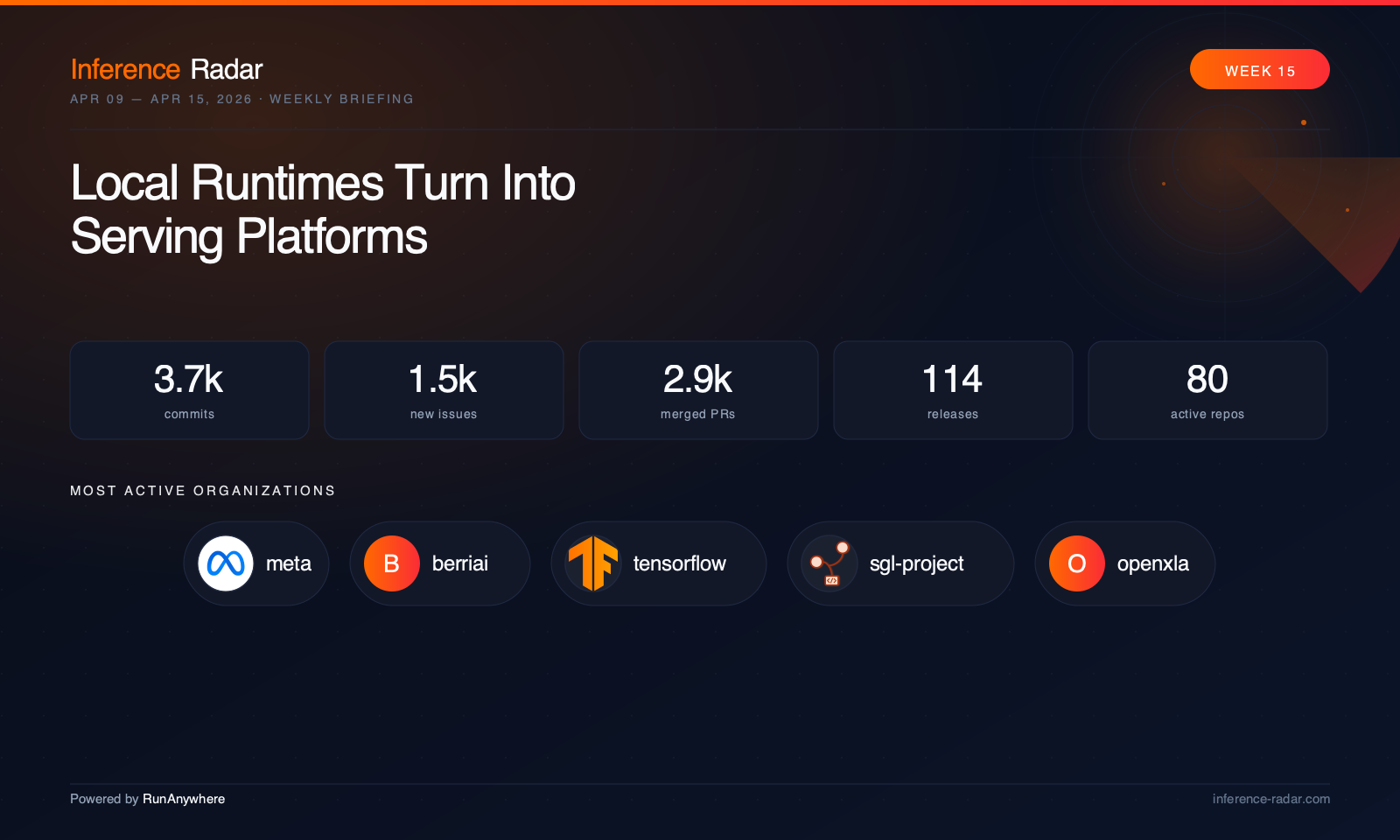

TL;DR
- Gemma support became a full-stack stress test: Ollama, llama.cpp, SGLang, vLLM, Apple’s MLX ecosystem, and multiple edge runtimes all spent the week shipping or stabilizing Gemma support, exposing how fast new model families now propagate across cloud, local, and mobile stacks.1
- Memory efficiency is the new battleground: vLLM pushed 2-bit KV-cache compression, llama.cpp expanded tensor parallelism and quantized backend work, and TensorRT-LLM plus ai-dynamo doubled down on KV-aware disaggregated serving.2
- Apple inference stopped being “just local”: mlx-swift-lm, mlx, Ollama, and adjacent MLX projects spent the week adding model coverage, stream/runtime fixes, and server-style features that make Apple Silicon look more like a serious deployment target than a developer convenience.1
- Edge frameworks are getting more ambitious, not smaller: LiteRT, ExecuTorch, MNN, ncnn, and sherpa-onnx all shipped work that expands multimodal, speech, or accelerator-specific inference rather than trimming scope.9
- Serving infrastructure is shifting from “fast API” to “control plane”: SGLang, ai-dynamo, Ray, and Triton Inference Server focused on routing, failover, observability, scheduler behavior, and OpenAI-compatible surfaces—the plumbing needed to run inference fleets, not just models.3
This Week in Inference
The biggest story this week is structural: the open-source inference ecosystem is no longer neatly separable into cloud serving engines, local runtimes, and edge frameworks. The same model families are now hitting all three layers almost simultaneously, and the same engineering problems—KV-cache pressure, tool-calling correctness, multimodal preprocessing, streaming semantics, and OpenAI-compatible APIs—are showing up everywhere from vLLM and SGLang to Ollama, Apple’s MLX stack, LiteRT, and MNN.1 Gemma was the clearest example: support and fixes landed across datacenter, desktop, browser-adjacent, and mobile-oriented projects in the same week, turning one model family into a cross-stack integration benchmark.
The second major theme is memory. Not raw throughput, not benchmark theater—memory. vLLM added TurboQuant-based KV compression, llama.cpp pushed backend-agnostic tensor parallelism and more quantized backend coverage, SGLang spent heavily on cache correctness and long-lived session accounting, and NVIDIA’s stack across TensorRT-LLM and ai-dynamo kept moving toward cache-aware disaggregation and routing.2 That’s the real market signal: inference is increasingly constrained by how intelligently systems move, compress, and reuse state, not just how fast they multiply matrices.
The third theme is that Apple Silicon and edge deployment are maturing upward. Apple’s mlx-swift-lm had a major model-support week, mlx hardened stream handling and safetensors validation, and Ollama treated MLX as a first-class backend rather than a side path.1 Meanwhile, ExecuTorch, LiteRT-LM, MNN, ncnn, and sherpa-onnx all pushed deeper into real deployment concerns: Qualcomm backends, ARM lowering, speech pipelines, browser portability, and accelerator-specific correctness.10 The edge stack is no longer about toy demos. It’s becoming a serious downstream of the same model and serving ecosystem the cloud uses.
Top Stories
vLLM makes memory efficiency a first-class feature
vLLM landed two strategically important changes at once: a long-awaited migration toward the latest Transformers interface and a new TurboQuant-based 2-bit KV-cache compression path.4 That combination matters because it attacks the two biggest sources of friction in modern serving—ecosystem compatibility and memory footprint—without asking operators to choose between them. The result is that vLLM looks less like “the fast OpenAI-compatible server” and more like the reference implementation for dense, cache-heavy serving under real capacity pressure.
llama.cpp turns local inference into a multi-backend systems project
llama.cpp shipped the week’s most important local-runtime architectural change with experimental backend-agnostic tensor parallelism.2 That sounds incremental until you notice what it implies: the project is no longer just optimizing single-machine inference, it’s building a portable execution substrate that spans CUDA, Vulkan, Metal, SYCL, WebGPU, OpenVINO, Hexagon, and more. Add the week’s audio, multimodal, RDMA, and quantized backend work, and llama.cpp increasingly resembles a universal inference runtime rather than a “CPU-first local LLM app.”
Apple’s MLX ecosystem is becoming a deployment surface, not a hobbyist niche
Apple’s mlx-swift-lm had one of the strongest weeks in the ecosystem, with broad Gemma support and a long list of API, tool-calling, and integration fixes, while mlx itself tightened stream handling and runtime correctness.7 In parallel, Ollama poured effort into MLX backend support, fused execution, and Gemma-specific stabilization.1 Taken together, that’s a meaningful shift: Apple Silicon is being treated less like a developer workstation target and more like a serious inference platform with its own runtime, packaging, and serving expectations.
SGLang and Dynamo are racing toward the inference control plane
SGLang spent the week on distributed serving, session accounting, speculative decoding correctness, and HiCache maturity, while ai-dynamo pushed planner/replay integration, failover APIs, routing intelligence, and deeper observability.3 These are not “faster kernel” stories; they’re control-plane stories. The implication is that open-source inference competition is moving above the model server itself, toward the orchestration layer that decides where requests go, how state is reused, and how fleets recover under load.
Edge frameworks are absorbing multimodal and speech workloads faster than expected
LiteRT, ExecuTorch, MNN, sherpa-onnx, and ncnn all had weeks that expanded capability rather than just fixing bugs.9 Gemma multimodal support, Qualcomm and ARM backend work, ONNX Runtime upgrades, speech model packaging, and transformer-oriented Vulkan benchmarking all point in the same direction: edge inference is no longer downstream cleanup after cloud launches. It’s becoming a parallel product surface that expects near-immediate support for the same architectures and modalities.
Deeper Dive
Everything below is for readers who want the full picture. Feel free to scroll.
Code Changes by Category
Cloud & Datacenter Serving
vLLM had one of the week’s most consequential datacenter-serving cycles.4 The headline items were the merged Transformers migration and TurboQuant-based 2-bit KV-cache compression, but the broader pattern was just as important: speculative decoding support widened, KV connector plumbing got more explicit, XPU and CPU quantization paths improved, and the API surface kept tightening around realtime auth, tool calling, and streaming behavior. The repo’s issue queue also shows where pressure is building next: scheduler deadlocks under KV exhaustion, structured generation regressions, and a live debate over how much legacy quantization support the project should keep.
SGLang continued its transformation from a fast serving engine into a distributed inference platform.3 Native data parallel support in RayEngine, better placement-group behavior, and a long list of session-accounting and cache-finish fixes all point to a team optimizing for long-lived, multi-node production workloads rather than benchmark snapshots. The other notable thread was post-training and scoring support: pooled hidden states, rollout APIs, and diffusion-aligned work suggest SGLang wants to be useful not just for serving chat models, but for the broader inference-adjacent workflow around them.
NVIDIA TensorRT-LLM and ai-dynamo looked increasingly like two halves of the same stack.5 TensorRT-LLM pushed model onboarding, NVFP4 coverage, telemetry, Prometheus metrics, and disaggregated-serving fixes, while Dynamo focused on planner intelligence, replay integration, routing, failover, and operator lifecycle correctness. The shared theme is clear: NVIDIA is investing not just in kernels and model support, but in the control and observability layers needed to run inference as infrastructure.
Ray had a release-driven week, but the inference-relevant story was its continued convergence with the serving ecosystem.14 Ray LLM tracked newer vLLM support, SGLang integration kept maturing, and Serve documentation moved further into tokenization disaggregation and routing architecture. Meanwhile, HAProxy hardening, metrics cardinality fixes, and safer defaults around profiling show a project trying to make serving clusters more operable, not just more feature-rich.
Triton Inference Server was quieter, but the changes were high leverage.15 Disabling client shared memory by default is the kind of operational default shift that matters more than a flashy feature, and Azure Managed Identity support continues Triton’s pattern of meeting enterprise deployment environments where they are. The OpenAI-compatible frontend work also remains notable: Triton is still inching toward a world where “OpenAI-compatible” is table stakes for every serious serving layer.
LMDeploy had a solid maintenance-heavy week with kernel block-size tuning, a step-input refactor, OpenAI-route parameter expansion, and several lifecycle fixes around sessions and sleeping engines.17 It wasn’t a headline week, but it was the kind of work that makes a serving stack more trustworthy in production.
Local LLM Runtimes
llama.cpp dominated the local-runtime category.2 Experimental backend-agnostic tensor parallelism is the obvious headline, but the supporting work matters just as much: CUDA quantization support, Vulkan NVFP4 and Flash Attention improvements, RDMA transport in the RPC backend, OpenAI-compatible audio transcription, and ongoing parser/template fixes for fast-moving model families. The project’s release cadence remains unmatched, and the issue queue shows the cost of that speed: Gemma memory pressure, tensor-parallel crashes, and backend-specific regressions are all arriving in real time.
Ollama spent the week in rapid-response mode around Gemma and MLX.1 Full MLX backend support for Gemma, fused execution improvements, KV-cache fixes, prompt-template churn, and tool-calling stabilization all landed in a tight loop. The important strategic point is that Ollama is no longer just a packaging layer over local models; it is increasingly a runtime and compatibility layer with strong opinions about backend behavior, prompt rendering, and model UX.
LocalAI had a broader week than usual, adding an experimental tinygrad multimodal backend, another llama.cpp-family backend, streaming transcription support, and gallery updates for ASR and OCR models.18 The repo also kept pushing on API compatibility with vLLM- and Ollama-style surfaces. LocalAI’s direction is becoming clearer: it wants to be the “local inference platform” that can swap backends underneath a stable service layer.
oobabooga TextGen had a classic release-then-stabilize week.19 The rename from text-generation-webui to TextGen is cosmetic compared with the real work: Gemma template fixes, GGUF metadata repairs, UI scrolling and chat-state fixes, and fast hotfix releases after regressions. It remains one of the clearest examples of how local UI layers are now downstream of the same model-template and tool-calling churn affecting servers.
exo continued to stand out as a distributed local runtime rather than a single-box app.20 Gemma support, tensor parallelism, Flash Attention for newer models, prefix-cache fixes, and better tool-calling accounting all landed alongside dashboard and packaging polish. Exo is increasingly interesting because it treats local and clustered personal hardware as a continuum.
omlx shipped experimental DFlash speculative decoding and then immediately entered stabilization mode.21 That fast feedback loop—ship, benchmark, rollback pieces, harden memory accounting, fix tool-calling edge cases—is becoming common across the stack. It’s a sign that speculative decoding is moving from research curiosity into mainstream runtime experimentation, even on local Apple-centric systems.
llamafile was quiet in direct code terms, but its upstream sync with llama.cpp matters because it effectively imports a large slice of the week’s local-runtime progress.22 That remains the project’s core dynamic: it inherits capability from the fastest-moving local runtime while packaging it for broader distribution.
Apple Silicon & MLX Ecosystem
mlx-swift-lm was the center of gravity this week.7 Broad Gemma support across text, vision, and MoE variants was the obvious headline, but the more durable story is API maturation: embedder cleanup, prompt-cache round-tripping, tool-calling fixes, integration tests, and docs all moved together. That’s what a project looks like when it’s trying to become a stable application layer, not just a model demo.
mlx itself focused on runtime integrity.8 Thread-local stream handling, explicit cleanup, safetensors validation, and long-sequence mask fixes are the kind of changes that don’t trend on social media but determine whether an ecosystem can support real applications. If MLX is going to underpin more serious serving and app workloads, this is exactly the work it needs.
mlx-swift expanded binding completeness, especially around compile overloads and missing functions.23 That matters because the Swift layer is increasingly the bridge between Apple-native apps and the lower-level MLX runtime.
mlx-lm had a light merge week but a very active issue and PR queue.24 Dynamic quantization, Mamba kernels, Gemma parser fixes, KV-cache compression, and streaming behavior are all in motion. In other words, the repo is acting like a pressure valve for the next phase of Apple-native inference work.
coremltools stayed focused on conversion fidelity, adding support for operations that matter in modern decoder architectures.25 That’s a quieter but essential part of the Apple story: if conversion breaks, the rest of the stack doesn’t matter.
Outside Apple’s own repos, vllm-mlx had a notable week in the broader ecosystem, adding Prometheus metrics, cache and speculative-prefill fixes, sampling controls, and security hardening.26 It’s a useful signal that the MLX world is not just building runtimes; it’s building server-shaped products.
Mobile & Edge Frameworks
ExecuTorch had a strong backend-expansion week.10 Qualcomm QNN support broadened, ARM lowering kept maturing, CMSIS-NN INT8 support improved microcontroller deployment, and Vulkan plus XNNPACK safety work continued. The repo’s issue queue also shows where it’s headed next: more model coverage, better multimodal examples, and broader backend parity.
LiteRT and LiteRT-LM had one of the most coherent edge stories of the week.9 New evaluation tooling, a Gemini-compatible serve mode, execution-manager refactors, preprocessing alignment for Gemma, and a lot of platform stabilization across macOS and packaging all point to a stack trying to be both deployable and developer-friendly. LiteRT-LM in particular is inching toward a serious local/edge serving surface, not just a model runner.
MNN had a high-impact week by edge standards.11 Gemma multimodal support across text, vision, and audio is a major expansion, and the follow-up fixes around head-dim inference, KV reuse, Vulkan state reuse, and CUDA speculative decoding show the team understands that model support is only half the job. MNN is increasingly one of the more ambitious edge runtimes in the open-source stack.
ncnn stayed true to form with low-level performance work: RVV expansion, x86 BF16 improvements, Vulkan SDPA benchmarking, and conversion correctness.12 It remains one of the clearest examples of an edge framework that wins by relentless backend optimization rather than broad product messaging.
sherpa-onnx had a practical deployment week: ONNX Runtime upgrades, Android and Ascend-specific fixes, offline dependency download support, and memory-related session options.13 Speech stacks often get ignored in general inference coverage, but sherpa-onnx keeps showing how much real deployment work lives outside text generation.
web-llm was quieter, but the browser portability work matters.27 Runtime upgrades, subgroup WASM gating examples, and Next.js compatibility fixes are exactly the kind of changes that determine whether browser inference remains a novelty or becomes a dependable deployment target.
runanywhere-sdks had one of the more interesting cross-platform weeks: Qualcomm Genie NPU support, MetalRT work, Windows support, typed error unification, Flutter bridge fixes, and VAD infrastructure.28 It’s a reminder that “edge” increasingly means multi-platform SDK engineering, not just model conversion.
Compilers, Runtimes & Graph Engines
ONNX Runtime had a broad, provider-heavy week.29 CUDA Graph support in the plugin EP, WebGPU decode-path improvements, QNN and VitisAI fixes, and a long list of security and correctness patches reinforce ONNX Runtime’s role as the broadest general-purpose inference substrate in the ecosystem. It’s not the flashiest project week to week, but it remains one of the most strategically important.
TVM pushed in two directions at once: better model ingestion and better serving-oriented kernels.30 ONNX quantization frontend support, TFLite import expansion, and Relax-side KV/prefill work all matter because they improve TVM’s position as a bridge between model formats and optimized execution.
OpenVINO and openvino.genai had a dense week of runtime, NPU, and multimodal work.31 Core runtime fixes, GenAI sampling and VLM corrections, benchmark tooling, and NPU/Gemma follow-up all point to a stack that’s trying to stay relevant across both classic deployment and newer LLM/VLM workloads.
Triton continued its backend-heavy march, especially on AMD support.33 The mix of AMD enablement, NVIDIA TMA work, verifier improvements, and CI expansion reinforces Triton’s role as a compiler substrate for the rest of the inference ecosystem. The reverted Hopper/Blackwell TMA feature is also a good reminder that backend maturity is still uneven even in the most advanced compiler layers.
XLA and the mirrored TensorFlow-side XLA work kept pushing GPU runtime modernization, command-buffer migration, sharding correctness, and ROCm/SYCL portability.34 This is deep infrastructure, but it matters because many higher-level frameworks inherit these capabilities indirectly.
OpenXLA, TensorFlow, and JAX together painted a picture of a compiler/runtime layer that is still very active beneath the serving surface.34 Even when the user-facing story is “new model support,” the enabling work often lives here.
Models, Quantization & Optimization
The week’s model-support story was dominated by Gemma, but the more interesting pattern was how model support now arrives bundled with parser fixes, tool-calling fixes, preprocessing alignment, and backend-specific correctness work. Transformers kept tightening multimodal serve support and Gemma stabilization, Ollama and TextGen chased template changes, llama.cpp fixed parsing edge cases, and LiteRT aligned image preprocessing.1 “Model support” increasingly means full-stack behavioral compatibility, not just loading weights.
Quantization was similarly broad. vLLM pushed KV compression, TensorRT-LLM expanded NVFP4 coverage, llama.cpp kept adding quantized backend support, ktransformers improved CPU GPTQ INT4 kernels, neural-compressor focused on save/load reliability, and ai-edge-quantizer improved long-job usability and memory checks.2 The center of gravity is shifting from one-shot weight quantization toward runtime-aware quantization and cache compression.
Speech and audio also had a strong week. mlx-audio, mlx-audio-swift, FluidAudio, llama.cpp, LocalAI, and sherpa-onnx all shipped meaningful audio or ASR/TTS work.2 That’s worth noting because the inference conversation still skews too text-centric relative to where open-source deployment is actually going.
Other Notable Changes
Open WebUI had no commit-heavy headline, but its merged PR stream shows a platform hardening around permissions, model access, retrieval, and proxy behavior.44 That matters because UI layers are increasingly where enterprise and team workflows meet the serving stack.
LiteLLM had a huge week around streaming correctness, provider compatibility, file content streaming, orchestration loops, and proxy hardening.45 It continues to evolve from “API shim” into a policy and routing layer that sits above model servers.
WhisperKit / argmax-oss-swift focused on packaging consolidation, which is strategically small but important.46 Dependency simplification is often what turns an interesting SDK into a usable one.
Community Pulse
The loudest community signal this week was not a single repo but a cross-repo pattern: users are now stress-testing new model families across every layer of the stack within days. Gemma-related issues appeared in llama.cpp, Ollama, TextGen, Transformers, LiteRT, MediaPipe, OpenVINO, mlx-lm, and more.1 That’s a sign of healthy adoption, but also of a new burden on maintainers: model launches now trigger ecosystem-wide compatibility work immediately.
The second strong community theme was tool calling and structured output. Issues and fixes around tool-call parsing, streaming deltas, multi-tool responses, and template changes showed up in LiteLLM, vLLM, Ollama, TextGen, mlx-lm, and exo.1 The old assumption that “OpenAI-compatible” means text-in, text-out is clearly obsolete.
Third, there is growing user demand for better operational behavior, not just more models. Requests around failover, session-aware routing, backpressure, metrics, cache invalidation, and security defaults appeared in ai-dynamo, Ray, Triton Inference Server, Open WebUI, and TensorRT-LLM.5 The community is increasingly acting like operators, not just tinkerers.
Worth Watching
Watch the memory-efficiency race. vLLM pushed KV compression, Ollama has open KV compression work, mlx-lm has TurboQuant KV proposals, llama.cpp keeps broadening quantized backend support, and TensorRT-LLM plus SGLang are both deep in cache-management work.1 Expect KV-cache handling to become one of the main competitive axes across the stack.
Watch Apple as a deployment tier. The combination of mlx-swift-lm, mlx, Ollama, vllm-mlx, and the active mlx-lm queue suggests Apple Silicon is moving from “great local dev box” to “credible small-scale serving target.” If that continues, expect more server-style features, observability, and multi-model orchestration in MLX-adjacent projects.1
Watch the control-plane layer above model servers. ai-dynamo, Ray, SGLang, and LiteLLM are all, in different ways, moving upward into routing, policy, orchestration, and fleet behavior.3 The next phase of competition may be less about who serves one model fastest and more about who can coordinate many models, many backends, and many request types most reliably.
Watch edge multimodality. MNN, ExecuTorch, LiteRT-LM, sherpa-onnx, mlx-audio, and LocalAI all point to a future where speech, vision, and text are expected on-device by default.10 The edge stack is not narrowing; it’s broadening.
Major Releases
Ollama shipped five releases in rapid succession, all centered on Gemma support, MLX backend stabilization, prompt/template fixes, and ROCm compatibility. The dominant theme was fast-follow hardening after a major model/backend push, with Gemma tool-calling and Apple Silicon behavior getting the most attention. Latest release48
llama.cpp maintained its trademark release torrent, but the week’s center of gravity was clear: experimental backend-agnostic tensor parallelism, followed by rapid backend and modality expansion across Vulkan, CUDA, RDMA, audio transcription, and quantized kernels. This was the most important local-runtime release train of the week because it materially expanded what “local” can mean. Representative release49
mlx-swift-lm published its first release in the new line while landing broad Gemma support, API cleanup, tool-calling fixes, and package decoupling. The release signals that Apple-native LLM tooling is moving from experimental velocity toward a more stable application-facing surface. 50
LiteRT shipped a release focused on API cleanup, build stability, and Python compiled-model environment support, while LiteRT-LM paired that with a release and a strong week of evaluation, serve-mode, and execution-manager work. The combined theme was edge deployment maturity rather than flashy new model launches. LiteRT release51
Transformers shipped four patch releases in one week, with the dominant theme being Gemma stabilization, export and device-map fixes, and patch-level training/runtime correctness. The cadence reflects how quickly core model libraries now have to respond when a major new architecture lands across the serving ecosystem. Latest release52
LiteLLM shipped multiple stable, nightly, and release-candidate cuts, all centered on streaming correctness, provider compatibility, proxy hardening, and orchestration features. The most impactful change was improved tool-call and file-streaming behavior, reinforcing LiteLLM’s move from compatibility shim to control layer. Latest significant release53
TensorRT-LLM shipped a major prerelease focused on model onboarding, sliding-window attention, MoE support, and API updates, while the surrounding week added telemetry, Prometheus metrics, and more quantization coverage. The release underscores NVIDIA’s continued push to make TensorRT-LLM both broader in model support and deeper in production readiness. 54
SGLang shipped a post release primarily to fix a FlashInfer downloader issue, but the broader weekly theme was much larger: distributed serving, session correctness, HiCache maturity, and post-training support. The release itself was small; the surrounding code velocity was not. 55
Ray shipped a substantial platform release with notable inference relevance through Ray Data improvements, Serve hardening, and continued LLM integration work around vLLM and SGLang. The dominant theme was production maturity across the broader serving platform. 56
sherpa-onnx shipped two releases in quick succession, anchored by an ONNX Runtime upgrade, packaging fixes, and model refreshes. The week’s dominant theme was deployability across Android, Windows, Ascend, and offline environments rather than new speech features. Latest release57
omlx shipped a release and release candidate centered on experimental DFlash speculative decoding, then spent the rest of the week stabilizing the rollout with memory, tokenizer, and tool-calling fixes. It was one of the clearest examples this week of aggressive inference experimentation paired with immediate operational feedback. 58
TextGen shipped three releases in one day around its rebrand from text-generation-webui, then rapidly fixed Gemma compatibility, GGUF metadata handling, and UI regressions. The release train reflects a project trying to modernize its identity while keeping pace with fast-moving local-model behavior. Latest release59
Qualcomm shipped multiple releases across ai-hub-models and ai-hub-apps, with the dominant theme being metadata migration, export reliability, packaging, and app distribution workflows. The most impactful change was the tightening of the model/app delivery pipeline for Snapdragon-targeted deployment. Representative release60
ROCm AITER shipped two releases focused on OPUS migration, newer AMD target support, and a post-release fix for fused quantization kernel validation. The broader weekly theme across ROCm’s inference stack was kernel maturity translating into serving features through adjacent projects like ATOM. Latest release61